
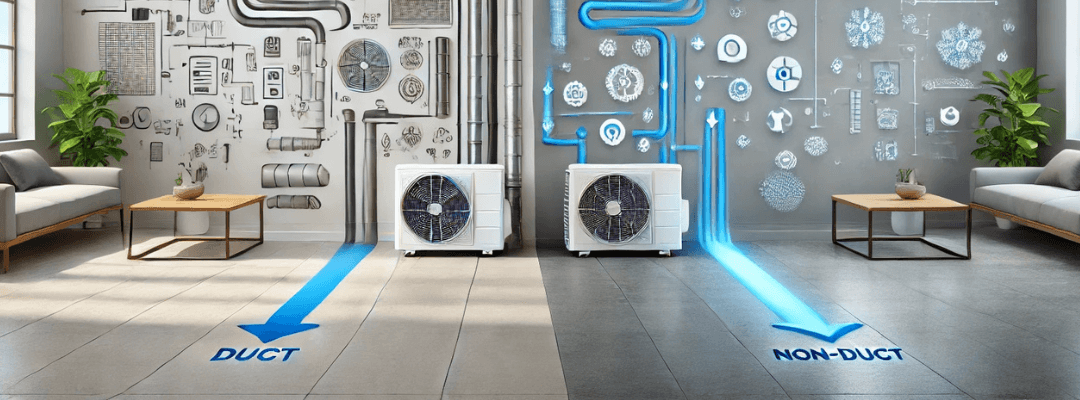
When choosing an air conditioning system, one of the key decisions is whether to opt for a ducted or non-ducted system. Both have unique features, advantages, and ideal applications. Here’s a detailed comparison:
1. Definition
- Ducted Air Conditioning System: Uses a network of ducts to distribute cooled or heated air from a central unit to different rooms or zones within a building.
- Non-Ducted Air Conditioning System: Does not use ducts; instead, it directly delivers cooled or heated air into the room or space from individual units.
2. Types
- Ducted Systems:
- Central Air Conditioning
- Packaged Units
- Variable Refrigerant Flow (VRF) with ducting
- Non-Ducted Systems:
- Split Systems (Wall-mounted, Floor-standing, Ceiling-mounted)
- Window Units
- Portable Air Conditioners
- Ductless VRF Systems
3. Installation
- Ducted Systems:
- Requires extensive ductwork installation, typically within walls, ceilings, or under floors.
- Best suited for new constructions or major renovations.
- Non-Ducted Systems:
- Easier and quicker to install; requires mounting the indoor unit and connecting it to an outdoor compressor via refrigerant pipes.
- Ideal for existing structures without ductwork.
4. Cost
- Ducted Systems:
- Higher upfront cost due to the need for ductwork and complex installation.
- Cost-effective for cooling/heating large spaces in the long run.
- Non-Ducted Systems:
- Lower initial cost; installation is less expensive.
- Operating costs may be higher if multiple units are required for larger spaces.
5. Aesthetic Impact
- Ducted Systems:
- Minimal visibility; air is delivered through discreet vents.
- A clean, seamless appearance ideal for homes or offices with modern interior designs.
- Non-Ducted Systems:
- Indoor units are visible (e.g., wall-mounted units).
- Offers flexibility in design but can impact aesthetics.
6. Energy Efficiency
- Ducted Systems:
- Can be less energy-efficient due to potential duct losses (leakage, poor insulation, etc.).
- Zoning options can improve efficiency by targeting specific areas.
- Non-Ducted Systems:
- Highly energy-efficient as they avoid duct losses.
- Advanced models often feature inverter technology for optimized performance.
7. Maintenance
- Ducted Systems:
- Regular duct cleaning is essential to prevent dust buildup and maintain air quality.
- Maintenance may involve complex inspections and repairs within the duct network.
- Non-Ducted Systems:
- Easier to maintain; involves cleaning filters and servicing the indoor/outdoor units.
- No ducts to clean or maintain.
8. Noise Levels
- Ducted Systems:
- Quieter as the central unit is often located away from living areas, and air travels through insulated ducts.
- Non-Ducted Systems:
- Some indoor units can be noisy, though modern designs minimize sound levels.
9. Flexibility
- Ducted Systems:
- Provides whole-house or large-area climate control.
- Zoning systems allow customization for different areas, but flexibility is limited compared to non-ducted systems.
- Non-Ducted Systems:
- Offers excellent flexibility, as individual units can be installed in specific rooms or zones.
- Ideal for spaces with varying cooling/heating needs.
10. Applications
- Ducted Systems:
- Large homes, offices, hotels, or buildings requiring centralized air conditioning.
- Ideal for concealed installations and unified temperature control.
- Non-Ducted Systems:
- Single rooms, apartments, small offices, or spaces without ductwork.
- Suitable for retrofitting or temporary cooling needs.
Comparison Table
| Aspect | Ducted System | Non-Ducted System |
| Installation | Complex, requires ductwork | Simple, quick installation |
| Cost | Higher upfront cost | Lower initial cost |
| Aesthetics | Discreet, vent-based design | Visible indoor units |
| Energy Efficiency | Potential losses through ducts | Highly energy-efficient |
| Maintenance | Duct cleaning needed | Minimal maintenance |
| Noise Levels | Quieter operation | Slightly noisier (depends on unit) |
| Flexibility | Whole-house control | Room-specific cooling |
| Applications | Large spaces, modern interiors | Small to medium spaces, retrofits |